Double Width Weaving
It is possible to weave a project twice the width of your loom by using a double weave technique. Half of the shafts of your loom weave the top layer of the warp and the other shafts weave the bottom layer, creating a folded edge on one side of the warp. I have used this technique to weave large queen size blankets.
When you are calculating the number of ends, remember that you are making a project that is double the width that is on your loom, so you will need to double the number of ends. For example, in this handspun blanket that I made, I used a sett of 5 e.p.i. The loom width was 54″. I needed 540 ends (54″ x 5) = 270 x 2 = 540. I threaded the loom at 10 e.p.i. as only half of the ends were used for each layer.
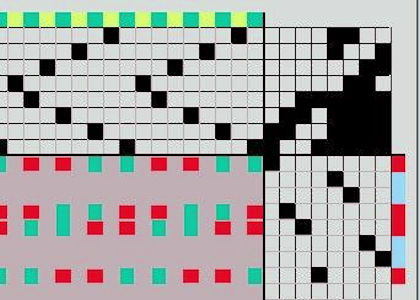
In this threading, the open side of the fabric is on the left, and the folded side is on the right. In double wide projects, there is quite a bit of draw-in on the folded side, so to compensate, I change the sett of the last inch of threads to 5 e.p.i.
You can weave a project twice the width of your loom by using a double weave technique. Half of the shafts of your loom weave the top layer of the warp and the other shafts weave the bottom layer, creating a folded edge on one side of the warp. I have used this technique to weave large queen size blankets.
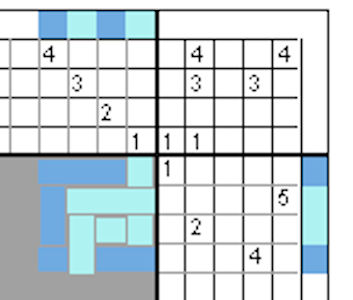
Although I used the same color of yarn for both layers, in this draft I have denoted the bottom and top layers with light and dark colors.
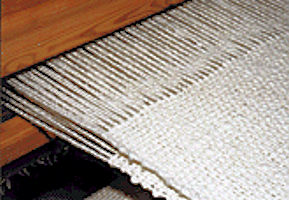
To begin weaving, I throw the shuttle from the left, on the bottom layer, creating the open side of the cloth.
The shuttle is then thrown from the right, on the top layer, creating a fold.
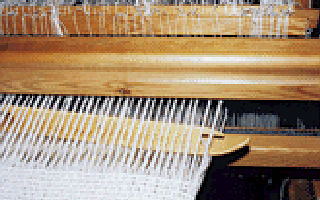
The shuttle is thrown from the left, on the top layer, back to the fold
and then from the right, on the bottom layer, back to the open side of the fabric. The warp must be tightly and evenly wound onto the back beam to avoid any loose warp threads. Tension problems in the warp will cause skips in the bottom layer.
It takes a bit of skill and faith that it will work, as you are weaving the bottom layer unseen, but the technique isn’t that difficult, even for a beginner weaver. I find this double weave technique to be quite useful as it expands the capabilities of even a small loom, allowing you to make much larger projects.
Draft for 8 Shaft Double Wide Twill
Weaving Drafts
Twill Tapestry
Summer Winter Draft
Log Cabin Draft
Finn Weave Draft
Handweaving Books
Doubleweave: On Four to Eight Shafts
Double Weave: Theory and Practice<
Magic of Doubleweave: The Best of Weaver’s (Best of Weaver’s series)
The Key to Weaving: A Textbook of Hand Weaving for the Beginning Weaver
The Weaver’s Companion (The Companion Series)
Learning to Weave
The Big Book of Weaving: Handweaving in the Swedish Tradition: Techniques, Patterns, Designs and Materials
The Handweaver’s Pattern Directory
A Weaver’s Book of 8-Shaft Patterns: From the Friends of Handwoven
Krokbragd: How to Design & Weave
SHOP ON EBAY FOR WEAVING LOOMS
BAND WEAVING
RIGID HEDDLE LOOMS
USED FLOOR LOOMS
 LONGTHREAD MEDIA VIDEO
 LONGTHREAD MEDIA SUBSCRIPTIONS
HANDWOVEN MAGAZINE
PIECEWORK MAGAZINE
SPINOFF MAGAZINE
LEARN LONGTHREAD MEDIA
PAIVATAR HANDMADE
LONGTHREAD MEDIA SUBSCRIPTIONS
HANDWOVEN MAGAZINE
PIECEWORK MAGAZINE
SPINOFF MAGAZINE
LEARN LONGTHREAD MEDIA
PAIVATAR HANDMADE
 Paivatar on YouTube
Visit my YouTube channel for how-to craft videos.
Paivatar on YouTube
Visit my YouTube channel for how-to craft videos.
Or Please visit my Channel on Rumble for more how-to videos.
https://rumble.com/Paivatar
LIVE STREAMS - Paivatar Studio
KICK
TWITCH MAKERS&CRAFTING
YOUTUBE
Categories: HAND WEAVING, How To, Patterns